
Practical Lifestyle
Mornings Always Rushed? A Realistic Routine for Busy Parents

A school-morning plan built backward from the time you leave: what to move to the night before, how to use a few fixed anchors, and a stripped-down version for the hard days.
9 min read
Most hard mornings aren’t caused by a lack of discipline. They come from too many decisions packed into too little time: what to wear, what to eat, where the library book is, who’s driving. A realistic morning routine moves as many of those decisions as possible out of the morning, builds the rest around a few fixed points, and has a stripped-down version ready for the days when everything goes sideways.
This guide is for households with school-age or younger children, but the same approach works for any morning with a hard departure time.
What this guide covers: the school morning itself: working back from departure time, a few fixed anchors, and a minimum version for hard days. Prep that happens the night before is covered in the evening reset routine, and weekly planning in the Sunday reset.
Sleep comes first
A morning routine starts the night before, with enough sleep. The CDC’s sleep recommendations are a useful check: 10 to 13 hours a day (including naps) for children ages 3 to 5, 9 to 12 hours for ages 6 to 12, 8 to 10 hours for teens, and 7 or more hours for adults. If a child has to be up at 6:30, a bedtime that allows that much sleep may be earlier than you think. A routine that depends on short sleep will keep breaking, however well it’s designed. Our 30-minute wind-down plan for adults covers the grown-up half of the evening.
1. Design from the departure time backward
Write down the time everyone needs to be out the door or logged on. Then list only the things that truly have to happen before then, and give each a realistic amount of time, based on what actually happens rather than what should happen. Add a buffer of 5 to 10 minutes before departure for the lost shoe or the last-minute bathroom trip.
A family leaving at 7:45 might end up with something like this:
- 6:45 adults up, coffee, medications
- 7:00 kids up, bathroom, dressed
- 7:15 breakfast
- 7:30 teeth, hair, sunscreen or coats
- 7:35 shoes on, bags at the door (buffer)
- 7:45 leave
If the timeline doesn’t fit, look for steps to move to the evening before you look for ways to wake up earlier.
2. Move decisions to the night before
Evening energy is limited too, but there’s usually more room for decisions than at 7:20 a.m. A ten-minute evening reset can cover:
- Clothes chosen and laid out, including socks, for anyone who needs help deciding.
- Bags packed and placed at the door: homework, library books, sports gear, signed forms.
- Lunches made and refrigerated, with cold packs ready in the freezer. Add them in the morning on the way out. Our guide to kids’ lunch containers explains why perishable lunches need two cold sources.
- Breakfast decided, with dry ingredients set out.
- Tomorrow’s unusual items checked: a field trip, an early meeting, a different pickup.
A single shared place for the calendar, permission slips, and the week’s schedule makes the last step much faster. Our guide to setting up a family command center shows how to keep one without adding clutter.
3. Use anchors rather than minute-by-minute control
A schedule timed to the minute falls apart the first time a child spills cereal. Anchors hold up better: a few fixed events the rest of the morning arranges itself around, such as “dressed before breakfast,” “breakfast done by 7:30,” and “shoes on at 7:35.” Children learn the sequence faster than a clock, and adults have fewer times to check and remind.
Keep the order the same every school day, even if the timing shifts a little. Predictability is what makes a routine feel automatic.
4. Make responsibilities visible
Give each person a short checklist suited to their age. Pre-readers do well with a strip of pictures: toothbrush, clothes, cereal bowl, backpack. Older children can use a written list taped inside a cupboard door or by the front door. Adults benefit too. If two adults share the morning, decide who owns which parts (breakfast, lunches, the younger child’s shoes) so no one is quietly carrying all of it. Our guide to sharing the mental load covers how to divide ownership, not just tasks.
Some children find time hard to sense. A visual timer that shows time disappearing can help with transitions, though others respond better to a song, a written list, or a calm reminder. Try one approach for a week before deciding.
5. Create a minimum viable morning
Decide in advance what the morning looks like on a bad day: someone is sick, the alarm didn’t go off, or a baby was up all night. List the few things that can’t be skipped, such as medications, something to eat, essential belongings, and getting to school safely, and let everything else go. Breakfast might be a banana and a cheese stick in the car. Hair might wait.
Having this written down takes the pressure off. A bad morning becomes a planned version, not a failure.
6. Repair the routine without blame
When a morning goes badly, look for the specific bottleneck rather than the person. Was it a missing shoe (shoe basket by the door), a breakfast negotiation (two set options), a phone that pulled an adult away (phone stays in the bedroom until 7:30), or a child who was simply too tired (earlier bedtime)? Change one thing at a time and give it a week.
A short weekly review helps. Our Sunday reset routine and midweek reset both include a quick look at what made mornings harder.
Breakfast that works on a weekday
Breakfast doesn’t need to be cooked to be good. A few options that take less than five minutes: oatmeal or whole-grain cereal with milk and fruit, yogurt with granola, toast with peanut butter, eggs boiled the night before, or a smoothie made from frozen fruit. Rotate two or three so no one has to decide each day.
Don’t forget the adults
Parents need a routine too. Put your own essentials, such as medications, keys, work bag, and a filled water bottle or coffee mug, in the same place every night. If you take a daily medicine, link it to an anchor you never skip, such as the first coffee. Keep medicines locked up or up high, out of children’s reach and sight, rather than on the breakfast table, and put them away after every use.
Twenty-minute planning exercise
Spend five minutes listing every task or object connected to your mornings. Circle the three that cause the most friction. Spend ten minutes deciding one change for each: something to move to the night before, an anchor, or a checklist. Use the last five minutes to tell everyone else in the household what’s changing. Try it for a week, then adjust.
Optional tools
A clock on the wall and a list on the door do most of the work. These can help in specific situations: a visual timer for children who struggle to sense time, and a leakproof mug for the adult drinking coffee in the car.
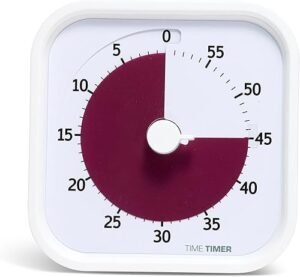
Visual Countdown Timer
Time Timer MOD Visual Timer
A compact visual countdown for people who benefit from seeing time disappear.
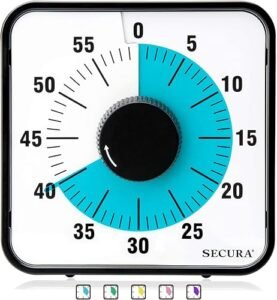
Secura 60-Minute Visual Timer
A larger dial-style option for kitchens, classrooms, and shared family spaces.
Leakproof Insulated Travel Mug
Contigo West Loop Travel Mug
A one-hand lid design for commuters who want a covered drinking mechanism.

Zojirushi Stainless Steel Mug
A slim insulated option for readers prioritizing temperature retention and bag-friendly shape.

Before buying any morning tool
Ask three questions: Which step actually runs late? Has a free fix been tried for a week? Will the item still be used in a month? A phone timer, a picture checklist drawn by your child, or a travel mug you already own often solves the same problem. If mornings are still a struggle, our 15-minute evening reset moves several decisions to the night before.
Minimum morning version for hard days
When the full routine collapses, keep only four moves: bathroom, clothes laid out the night before, bags at the door, and a breakfast that needs no cooking. Everything else is optional. Teach older kids the same four moves with a card on the wall so you are not narrating every step.
If mornings are still rushed after a week
- Decisions pile up at 7 a.m.: move clothes, bags, and breakfast choices into an evening reset.
- Only one adult carries the morning: split launch-pad jobs; use mental-load sharing for invisible prep.
- Kids stall the exit: use a visible sequence card (bathroom, clothes, shoes, bag) and reduce optional stops.
- Sleep debt is the real issue: protect wind-down with a 30-minute bedtime plan before adding more morning gadgets.
When to seek expert help
Most morning chaos improves with simpler systems, but sometimes the mornings are a sign of something else. Talk to your child’s pediatrician if your child regularly can’t wake up despite enough time in bed, snores loudly or seems sleepy during the day, has frequent stomachaches or headaches on school mornings, or becomes very distressed about going to school. The CDC suggests talking to a healthcare provider about regular sleep problems, and a provider may suggest keeping a sleep diary first.
Adults matter too. If you feel exhausted or overwhelmed most mornings, it’s worth raising with your own clinician.
Frequently asked questions
How early should parents wake up?
There’s no universal answer. Protect adequate sleep first, then allow enough time for the essential tasks. Don’t build a routine that depends on chronic sleep loss.
Do visual timers help every child?
No. They help some children understand transitions, while others respond better to a picture list, a music cue, or a calm verbal reminder.
What if mornings are still chaotic?
Simplify further and look at one bottleneck at a time, including bedtime, transportation, breakfast, or expectations that don’t fit the time available.
Key takeaways
- Build a morning routine from a realistic time budget—not an influencer checklist.
- Shift decisions to the night before: clothes, bags, breakfast, launch pad.
- Use a short visible sequence for kids and a minimum version for hard days.
- Fix sleep and shared labor before buying more organizers.
Related reads
Sources
- CDC – About Sleep (recommended hours by age)
- USDA Food Safety and Inspection Service – Keeping “Bag” Lunches Safe
- MedlinePlus – Medicine Safety and Children
Medical disclaimer
This is general information, not personal medical advice, diagnosis, or treatment. A clinician should guide decisions about symptoms, medicines, vaccines, pregnancy, or children. In an emergency, contact local emergency services.
Affiliate disclosure. This article contains Amazon affiliate links. If you buy through a qualifying link, Full Healthy Lives may earn a commission at no extra cost to you. Product mentions are optional, not medical advice.